FuelEU Maritime is established under Regulation (EU) 2023/1805. It forms part of the EU climate framework and sets requirements to reduce the greenhouse gas intensity of energy used on board ships calling at EU ports.
Key characteristics at a glance
Element
FuelEU Maritime
Mechanism
GHGIE Green House Gas Energy Intensity regulation
Cost driver
Non-compliance penalties
Ship threshold
≥ 5,000 GT
Geographic scope
EU/EEA ports
Gases covered
Well-to-wake GHG intensity
Start date
1st January 2025
Compliance party
ISM Company – DoC Holder
The regulation does not set a carbon price. Instead, it requires ships to remain below progressively tightening limits for the well to wake greenhouse gas intensity of their onboard energy use. Companies are free to choose how they comply, provided the required intensity limits are met.
Overview
FuelEU Maritime takes a goal-based, technology-neutral approach to maritime decarbonisation: shipping companies must ensure that the average GHG intensity of the energy used on board their vessels fall below mandated thresholds that become progressively stricter over time. The regulation encourages flexibility in compliance and operators can choose fuels or technologies that work best for their fleet.
Scope
Geographical coverage:
Ships calling at EU and European Economic Area (EEA) ports.
Due to EEA incorporation timing, Norway and Iceland is not yet included (indicated earliest jan 2028).
Ship size threshold:
Applies to commercial ships of 5,000 gross tonnage (GT) and above, regardless of flag.
Voyage Coverage:
FuelEU Maritime calculates energy use and GHG intensity based on:
100% of energy used on voyages between two EU/EEA ports and time at berth in EU/EEA ports.
50% of energy used on voyages between an EU/EEA port and a non-EU/EEA port.
Data is drawn from MRV fuel reporting.
Greenhouse gases / metrics covered:
FuelEU Maritime uses a well-to-wake (WtW) GHG intensity metric (gCO₂e/MJ) that includes lifecycle emissions of fuels used onboard, capturing CO₂, methane (CH₄) and nitrous oxide (N₂O) together using IPCC AR 4 GWP values to calculated CO₂eq.
Exemptions:
Typical exemptions under FuelEU include:
Warships and naval auxiliaries
Fish-catching or fish-processing ships
Wooden ships of a primitive build
Ships not propelled by mechanical means
Government ships used for non-commercial purposes
(Subject to national verification procedures)
Fuel-specific considerations:
Until 31 December 2033, RFNBO energy benefits from a reward factor in the FuelEU GHG intensity calculation, effectively improving the calculated compliance balance.
Ice class ships:
Ships with ice classes IC, IB, IA, IA Super, or equivalent may exclude additional energy consumption incurred due to sailing in ice conditions until end of 2034.
Start date
Monitoring and reporting: Some monitoring plan requirements applied from August 2024.
Full application: 1 January 2025.
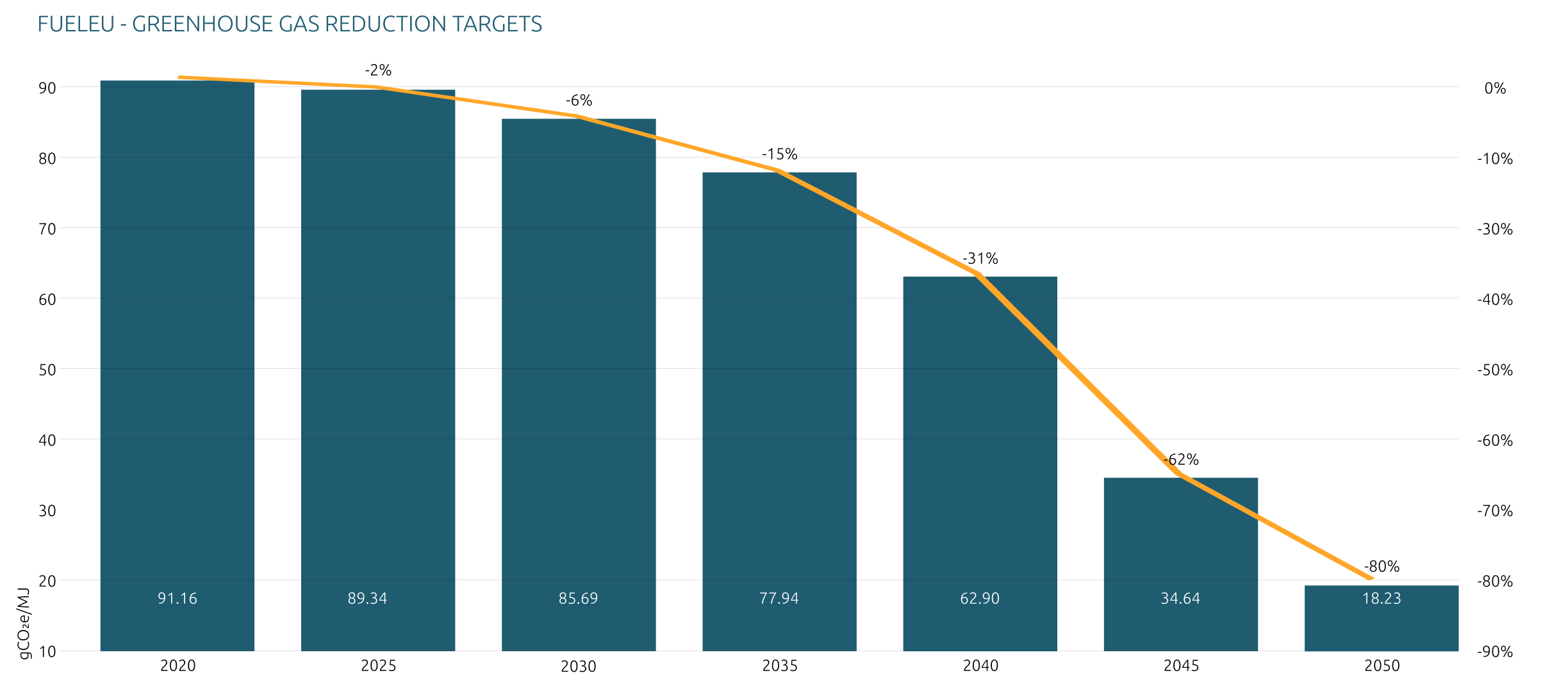
The greenhouse gas intensity reduction target begins with a 2 percent reduction compared to the 2020 reference value and increases progressively toward 2050, reaching up to 80 percent reduction.
FuelEU Maritime - GHG reduction targets
Responsibility
Shipping company (typically the entity responsible for compliance under existing EU MRV rules).
Cost Impact
FuelEU Maritime does not impose a direct per-tonne carbon price like EU ETS schemes. Instead, non-compliance with GHGIE triggers financial penalties. The actual costs for shipping companies depend on several factors, including:
Choice of fuels: Selection of energy sources with lower GHG intensity, whether conventional or renewable.
Adoption of incentivized alternatives: Use of solutions recognized under the regulation, such as shore power, Renewable Fuels of Non-Biological Origin (RFNBOs), or Wind-Assisted Ship Propulsion (WASP).
Pooling and compliance balances: If pooling across ships or using surplus compliance credits, associated costs depend on the market price of these credits within the company or between participating entities.
Compliance mechanism
Monitoring: Fuel consumption and energy use reported via EU MRV/THETIS.
Verification: Independent verification of energy use and GHG calculations.
Comparison: Annual GHG intensity is compared to regulatory limits.
Penalties: Ships above intensity limits incur penalties or must use flexibility mechanisms (pooling, etc.).
Using surplus compliance balances for commercial advantage
FuelEU Maritime allows shipping companies to manage their GHG intensity obligations strategically through two main flexibility mechanisms: banking and pooling across ships. These mechanisms can be leveraged to optimise costs, operational efficiency, and commercial outcomes.
1. Banking
Any surplus compliance balance (mt CO2eq) can be banked as a compliance balance and carried forward to offset emissions in future periods.
Commercial advantage:
As the thresholds decrease or a company anticipates higher emissions in upcoming voyages, it can “pre-pay” by over-complying in earlier periods.
Surplus balances can also be used to negotiate charter party terms, as lower carbon intensity ships can attract premium contracts or reduce shared compliance obligations.
2. Pooling across vessels
Different companies can pool their ships into a single compliance unit, averaging emissions across multiple vessels in their fleet.
Pooling allows operational flexibility: some ships may exceed intensity limits, and others may be cleaner, as long as the fleet-wide average meets the regulatory target.
Commercial advantage:
Enables strategic deployment of ships: vessels on longer or more fuel-intensive voyages can be offset by cleaner short-haul or LNG-fuelled ships.
Reduces the need for expensive low-carbon fuels on every vessel, lowering overall fuel costs while staying compliant.
Can be used to market greener fleet segments, giving a competitive edge in green cargo contracts.
Timing and fuel strategy
FuelEU permits the use of banked compliance credits within defined periods, meaning timing of fuel purchases and energy use matters.
Commercial advantage:
Companies can plan fuel procurement to take advantage of lower renewable fuel prices or port availability.
Combining compliance balance with voyage planning and speed optimisation allows operators to minimise cost per voyage while maintaining fleet-level compliance.
Flexibility under FuelEU is not just a compliance tool. When applied strategically, it becomes a commercial lever: lowering operational costs, optimising fleet deployment, and enhancing marketability in sustainability-conscious shipping contracts.
Commercial and operational implications
FuelEU influences:
Fuel procurement strategies.
Technology and energy efficiency investments.
Voyage and port operations.
Charter party clauses related to compliance obligations.
Planning fuel mixes and energy strategies is a long-term strategic business decision due to progressively tightening limits.
With multiple variables affecting compliance and costs, stakeholders should use collected data not only for reporting but also for strategic fleet planning to identify the most effective solutions.
For more guidance on navigating FuelEU requirements and optimizing fleet strategy, reach out to the Siglar Carbon team.
This website stores cookies on your computer. These cookies are used to collect information about how you interact with our website and allow us to remember you. We use this information to improve and customize your browsing experience, as well as for analytics and metrics about our visitors both on this website and other media. To learn more about our Cookie policy click here.


.jpg)


