FUELEU RISK MANAGER

Stay ahead of compliance 
- and avoid costly surprises

Get continuous insight into your compliance status,  so you can act early, optimise smartly, and avoid last-minute costs.

Fuel EU Manager

FUELEU MANAGER

What you get

Decision Making
Live compliance balance


Track eligible emissions and compliance balance in real time — by vessel, segment or fleet.

Alignment
Cost control

Understand potential penalties before they hit, and find best way to avoid a compliance deficit.

Insights
Decision support

Optimise your commercial decisions with data-backed insights.

EU ETS Cost
Settle at right price

Tools to settle compliance balance internally or externally, at the right price.

Understand total voyage economics

Get a complete view of voyage profitability with fuel, port, emissions, and regulatory costs included in one calculation.
Optimise bunker choices

Identify the fuel strategy that delivers the lowest combined cost across bunker fuel, emission allowances and compliance obligations.

Get started – it’s easy!

Being a Siglar client requires no IT investment and no installation. All you need to get started is a web browser.
Get in touch now, and we’ll tell you more!

FuelEU cheat sheet

FuelEU Maritime can be complex, but understanding the basics is key to make smart choices.

As a part of the EU goal to reduce GHG emissions by 55% by 2030, the FuelEU legislation targets the fuel itself. It adds significant cost on conventional fuels and potential benefit for alternative fuels.

The FuelEU introduces

  • Right facing arrow
Annual well-to-wake GHG intensity limits on energy used onboard ships from 2025
  • Right facing arrow
Obligation to use on-shore power supply or zero-emission technology in EU ports
  • Right facing arrow
Financial penalties for non-compliance
  • Right facing arrow
Voluntary pooling mechanism allowing to pool the compliance balance of one or more ships

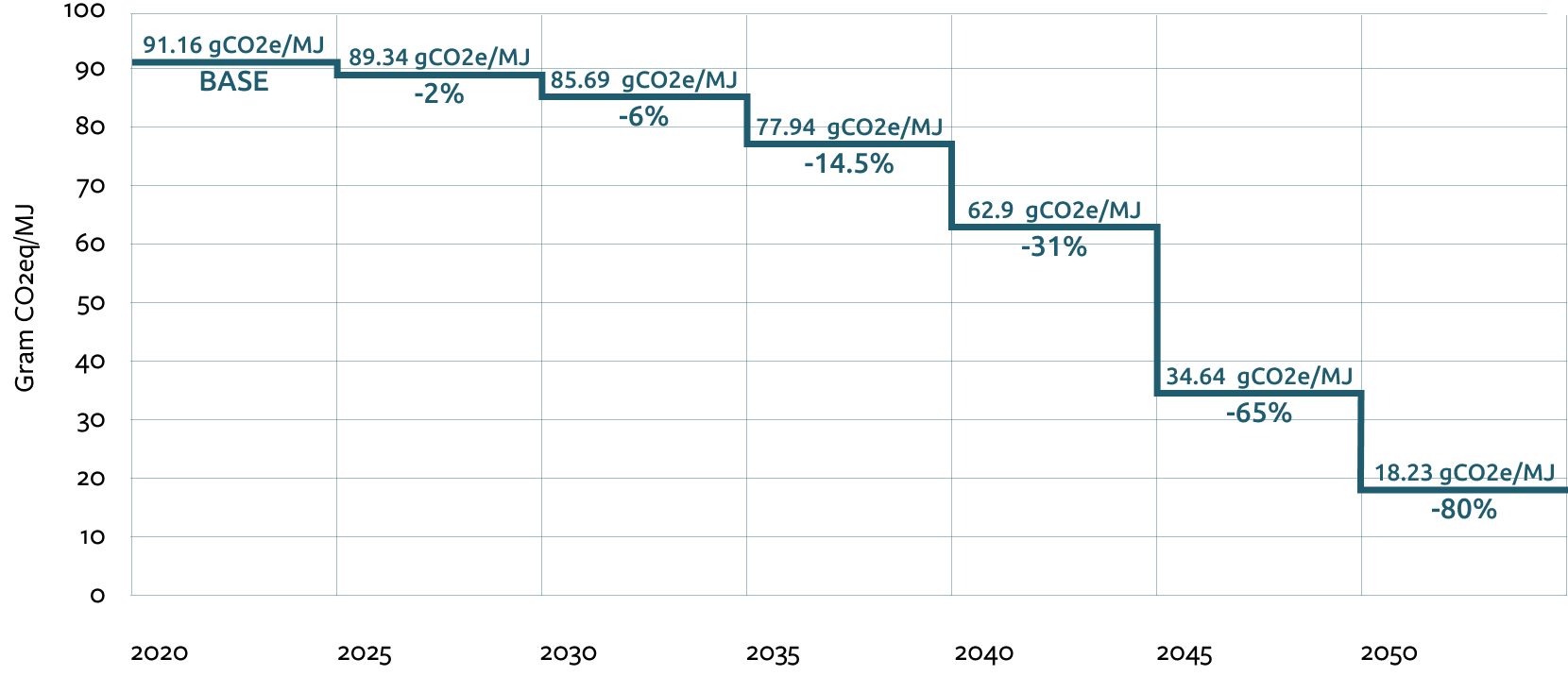
The GHG intensity means the amount of CO2, CH4 and N2O emissions per MJ of energy used, expressed in grams of CO2 equivalents. Emissions are calculated in a well-to-wake (WTW) perspective and include emissions related to extraction, cultivation, production and transportation of the fuel, in addition to emissions from combustion of fuel used. The yearly limits are set as a percentage reduction relative to the fleet average GHG intensity in 2020 (91.16 gCO2/MJ).

GHG Intensity limits

Compliance balance

Compliance balance is the difference between your ship’s actual GHG emissions and its allowed GHG emissions. It is measured in tonnes WTW CO2e.

The energy consumed by the ship through the year - multiplied with the GHG intensity limit - sets the allowed emissions.

A ship’s annual compliance balance is reported to the EU, and any compliance balance deficit will result in a penalty.

Compliance surplus and deficit possibilities

A compliance surplus or deficit represents an asset, and it can be handled in different ways.

Compliance surplus
  • Bank
  • Include in pool
Compliance deficit
  • Borrow advance surplus from next year (max 2%)
  • Include in pool
  • Pay penalty

Penalty

The penalty for annual deficit is set at

EUR 2,400

per tonne of VLSFO-equivalent.

Pooling

Compliance balances may be pooled for the purposes of FuelEU compliance.

  • The pool is not limited to ships of the same company.
  • A ship’s compliance balance may not be included in more than one pool in the same reporting period.
  • Pools are based on compliance balance, where one tonne of CO2e surplus cover for on tonne of CO2e deficit.
  • A pool must always deliver a combined compliance surplus.

Whereas the penalty is measured in “tonnes of VLSFOe”, the compliance balance is measured in “tonnes of CO2e”. Hence, it is not a 1-to-1 conversion. Therefore, the penalty for each unit of compliance balance varies for each ship, and affects each participant’s willingness to pay.

Map showing the EU and EEA scope of FuelEU Maritime regulation

Scope of regulation

The regulation applies to

  • ships above 5000 gross tonnage,
  • 100% of energy used in EU or EEA ports,
  • 100% of energy used on voyages between EU or EEA ports,
  • 50% of energy used on voyages into or out of the EU or EEA, and
  • well-to-wake GHG emissions (CO2, CH4, N2O)

*Due to EEA incorporation timing, Norway and Iceland is not yet included (indicated earliest January 2028)

FuelEU annual reporting timeline

From uncertainty to control

FuelEU Manager A

"Track performance, forecast risk, and make informed decisions. All in one place."

Whether you’re just getting started or leading the way in shipping decarbonisation, you can make carbon efficient and profitable shipping decisions using the Siglar solutions.

top-page button