
2025 marks the first year of FuelEU Maritime reporting, and shipowners along with their managers are now preparing their data ahead of the 31 March submission deadline. Among the new requirements, one mechanism stands out as complex, yet important, if you want to cut compliance costs: fuel allocation.
Fuel allocation unlocks substantial cost savings. Still, many systems do not support this. When the allocation opportunity is overlooked, it leaves owners with inflated compliance deficits. At Siglar Carbon, we see the allocation mechanism as an effective no-cost optimisation available under FuelEU. That’s why it’s incorporated as a default feature across the Siglar platform.
Fuel allocation is not a loophole. It is a built-in optimisation mechanism designed to encourage the use of better, lower intensity fuels also on the extra-EU voyages, where only 50% of the fuel consumption counts under the FuelEU scope.
Since extra-EU voyages are only partially within Fuel EU scope, the regulation gives owners the ability to choose which fuels they report for this 50% share. In practice, this means owners may replace higher intensity fuels (such as VLSFO) with the energy equivalent amount of lower intensity fuels they used during the year, such as B24 or B30, LFO or even MGO.
This ensures that owners who make an effort to use cleaner fuels, are rewarded in their FuelEU compliance calculations.
A common misconception is that the allocation must happen within the boundaries of a single voyage. This is not the case. Fuel allocation is done per ship, across all intra-EU and extra-EU voyages within the FuelEU scope for the complete reporting year.
This gives owners substantial flexibility. Even if a ship used a lower intensity fuel on only a handful of voyages or even just one, that fuel can be applied to the rest of the voyages where it delivers the greatest compliance benefit.
In other words: FuelEU cares about the ship’s annual energy profile, not the sequence in which individual fuels were burned.
Consider an owner with three ships performing around 50 extra-EU voyages during 2025.
Across the fleet:
• One ship used B24 on a couple of voyages.
• The others consumed a mix of VLSFO and MGO on most voyages.
Despite the limited use of lower intensity fuels, all three ships improved their compliance balance through optimising fuel allocation:
• The ship with B24 achieved the largest improvement, reducing its compliance balance by 341 units.
• The other two ships, despite relying mainly on VLSFO and MGO, still benefited significantly, reducing their compliance balances by 47 and 55 units respectively.
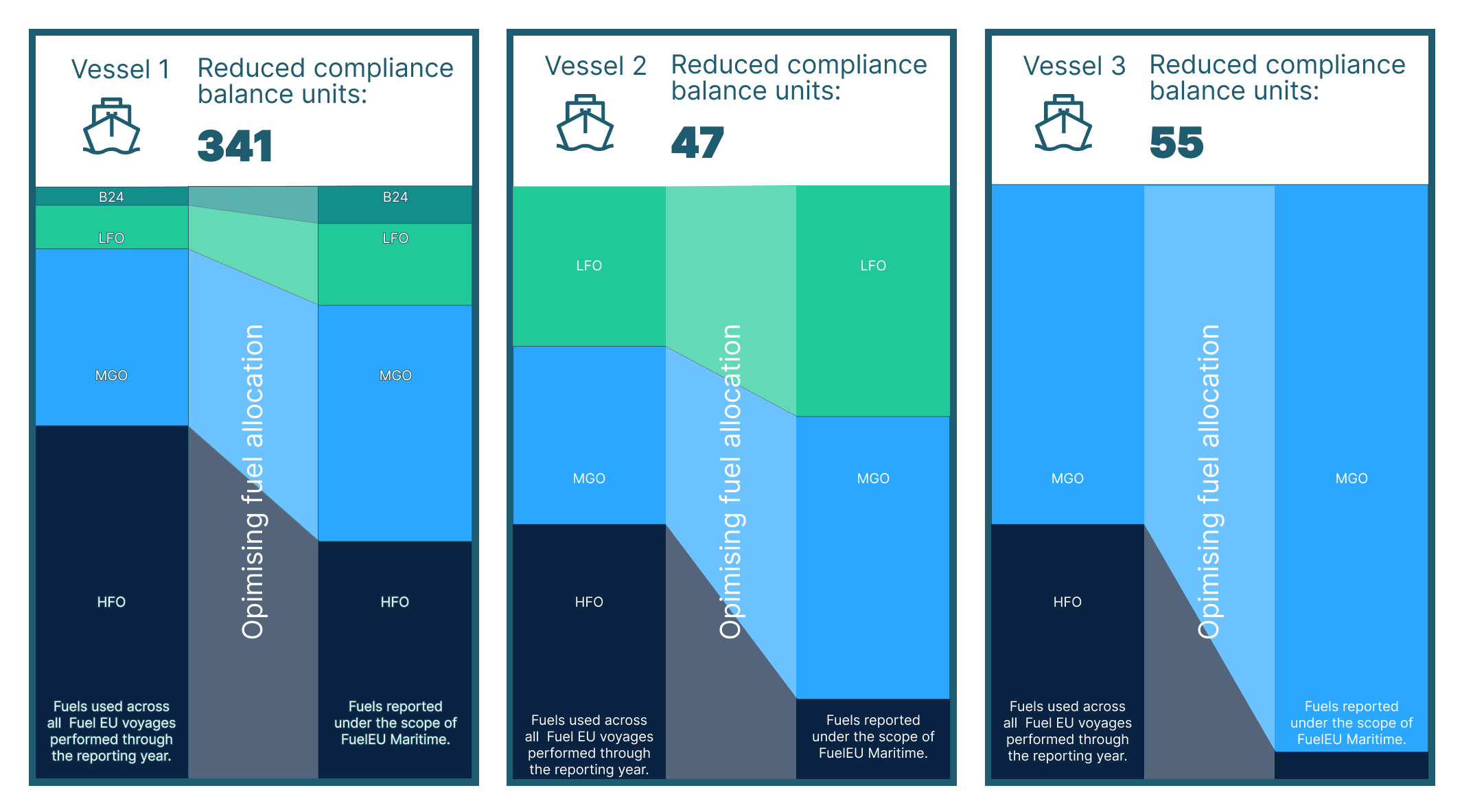
In total, fuel allocation reduced the combined compliance balance by more than 20%. An improvement coming solely from reporting optimisation, not from burning any additional alternative fuel.
Fuel allocation does not happen automatically. Owners must actively optimise how they report fuel usage before submitting their verified FuelEU data, 31 March. For many, this will mean the difference between a manageable compliance outcome and a costly penalty.
Because fuel allocation is:
• Fully compliant
• Cost-free
• Straightforward when handled correctly
• High impact, especially for fleets with extra EU trading
…it should be considered an essential part of every shipowner’s FuelEU strategy.
As FuelEU takes effect, the industry is entering a new era of emissions compliance. Fuel allocation is a clear example of how streamlined reporting and monitoring coupled with Siglar tools can reduce costs, while supporting longer term decarbonisation ambitions.

2025 marks the first year of FuelEU Maritime reporting, and shipowners along with their managers are now preparing their data ahead of the 31 March submission deadline. Among the new requirements, one mechanism stands out as complex, yet important, if you want to cut compliance costs: fuel allocation.
Fuel allocation unlocks substantial cost savings. Still, many systems do not support this. When the allocation opportunity is overlooked, it leaves owners with inflated compliance deficits. At Siglar Carbon, we see the allocation mechanism as an effective no-cost optimisation available under FuelEU. That’s why it’s incorporated as a default feature across the Siglar platform.
Fuel allocation is not a loophole. It is a built-in optimisation mechanism designed to encourage the use of better, lower intensity fuels also on the extra-EU voyages, where only 50% of the fuel consumption counts under the FuelEU scope.
Since extra-EU voyages are only partially within Fuel EU scope, the regulation gives owners the ability to choose which fuels they report for this 50% share. In practice, this means owners may replace higher intensity fuels (such as VLSFO) with the energy equivalent amount of lower intensity fuels they used during the year, such as B24 or B30, LFO or even MGO.
This ensures that owners who make an effort to use cleaner fuels, are rewarded in their FuelEU compliance calculations.
A common misconception is that the allocation must happen within the boundaries of a single voyage. This is not the case. Fuel allocation is done per ship, across all intra-EU and extra-EU voyages within the FuelEU scope for the complete reporting year.
This gives owners substantial flexibility. Even if a ship used a lower intensity fuel on only a handful of voyages or even just one, that fuel can be applied to the rest of the voyages where it delivers the greatest compliance benefit.
In other words: FuelEU cares about the ship’s annual energy profile, not the sequence in which individual fuels were burned.
Consider an owner with three ships performing around 50 extra-EU voyages during 2025.
Across the fleet:
• One ship used B24 on a couple of voyages.
• The others consumed a mix of VLSFO and MGO on most voyages.
Despite the limited use of lower intensity fuels, all three ships improved their compliance balance through optimising fuel allocation:
• The ship with B24 achieved the largest improvement, reducing its compliance balance by 341 units.
• The other two ships, despite relying mainly on VLSFO and MGO, still benefited significantly, reducing their compliance balances by 47 and 55 units respectively.
In total, fuel allocation reduced the combined compliance balance by more than 20%. An improvement coming solely from reporting optimisation, not from burning any additional alternative fuel.
Fuel allocation does not happen automatically. Owners must actively optimise how they report fuel usage before submitting their verified FuelEU data, 31 March. For many, this will mean the difference between a manageable compliance outcome and a costly penalty.
Because fuel allocation is:
• Fully compliant
• Cost-free
• Straightforward when handled correctly
• High impact, especially for fleets with extra EU trading
…it should be considered an essential part of every shipowner’s FuelEU strategy.
As FuelEU takes effect, the industry is entering a new era of emissions compliance. Fuel allocation is a clear example of how streamlined reporting and monitoring coupled with Siglar tools can reduce costs, while supporting longer term decarbonisation ambitions.


