
From 1 July, the UK Emissions Trading Scheme (UK ETS) becomes a new cost layer for shipping activity linked to the UK. While the regulation itself is not unexpected, the commercial implications are still widely underestimated.
For many market participants, the key question is not what the regulation says, but:
What does this actually mean for voyage economics?
The introduction of UK ETS creates an additional carbon cost alongside existing mechanisms like EU ETS.
For charterers, owners, and brokers, this means:
Even small differences in routing, port calls, or vessel efficiency can now have material cost implications.
Historically, emissions reporting has been backward-looking.
But carbon pricing changes the equation.
To stay competitive, market participants need to:
This requires decision support, not just reporting.
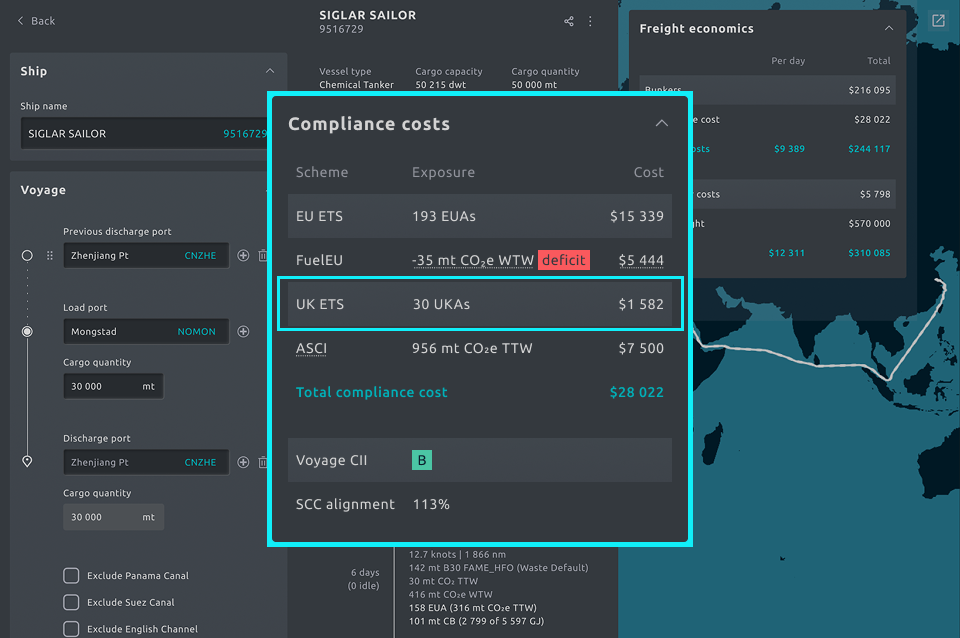
With the latest update to the Siglar Platform, users can now:
This makes it possible to integrate UK ETS into day-to-day commercial decisions, not just post-voyage analysis.
Carbon pricing in shipping is no longer a future scenario.
With overlapping regimes (EU ETS and FuelEU today, UK ETS upcoming and IMO measures ahead), the market is moving toward a reality where carbon cost becomes a core component of freight competitiveness.
A shared view of expected carbon liability, cost recovery opportunities, and risk of margin erosion across commercial, compliance, and finance teams allows you to act early and get a clear competitive advantage.
You can already explore the impact of UK ETS on your operations with our free Estimator trial.
For many market participants, the key question is not what the regulation says, but:
What does this actually mean for voyage economics?
The introduction of UK ETS creates an additional carbon cost alongside existing mechanisms like EU ETS.
For charterers, owners, and brokers, this means:
Even small differences in routing, port calls, or vessel efficiency can now have material cost implications.
Historically, emissions reporting has been backward-looking.
But carbon pricing changes the equation.
To stay competitive, market participants need to:
This requires decision support, not just reporting.
With the latest update to the Siglar Platform, users can now:
This makes it possible to integrate UK ETS into day-to-day commercial decisions, not just post-voyage analysis.
Carbon pricing in shipping is no longer a future scenario.
With overlapping regimes (EU ETS and FuelEU today, UK ETS upcoming and IMO measures ahead), the market is moving toward a reality where carbon cost becomes a core component of freight competitiveness.
A shared view of expected carbon liability, cost recovery opportunities, and risk of margin erosion across commercial, compliance, and finance teams allows you to act early and get a clear competitive advantage.
You can already explore the impact of UK ETS on your operations with our free Estimator trial.


